

Disabled Alabamians Are Being Left Behind, The Corina Mae Foundation Raises Alarm Over a Growing Disability Crisis
A call to recognize the unseen barriers and rebuild accessibility across all 67 counties
Across Alabama, disabled adults and seniors are facing a crisis that rarely makes headlines but affects thousands of families every single day. From rural transportation deserts to inaccessible healthcare, social isolation, and digital barriers, disabled Alabamians are being left behind - and the gap is widening.
The Corina Mae Foundation is sounding the alarm. As we continue building a statewide network dedicated to disability inclusion, we are witnessing firsthand how structural barriers, limited resources, and decades of underinvestment have created a quiet emergency across our communities.
This crisis is not theoretical. It is lived daily by people who cannot reach medical appointments, who go weeks without social interaction, who struggle to navigate complex systems, and who lack the support needed to live with dignity and independence. Alabama’s disabled population deserves better - and meaningful change begins with awareness.
The Hidden Barriers Fueling Alabama’s Disability Crisis
Transportation Deserts
Transportation is one of the most significant barriers for disabled Alabamians.
-
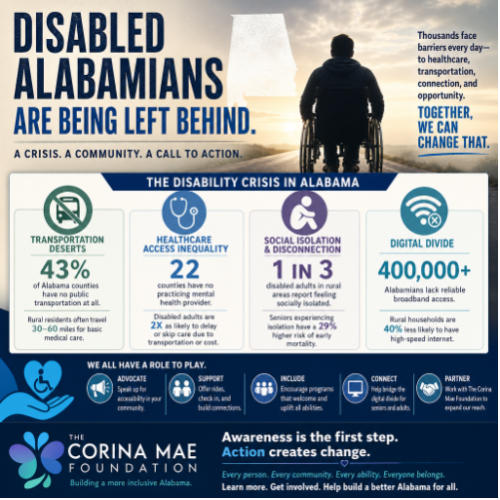
43% of Alabama counties have no public transportation at all.
-
Rural residents often travel 30-60 miles for basic medical care.
-
Many seniors rely entirely on family or neighbors for transportation, leaving them stranded when help isn’t available.
Without reliable transit, disabled residents cannot access medical care, groceries, community events, or essential services. A simple ride can determine whether someone receives treatment or remains isolated.
Healthcare Access Inequality
Healthcare access varies dramatically across the state.
-
Alabama has one of the lowest doctor-to-patient ratios in the country.
-
22 counties have no practicing mental health provider.
-
Disabled adults are twice as likely to delay or skip care due to transportation or cost barriers.
Specialists are often hours away, and appointment availability is limited. Disabled Alabamians must navigate long distances and complex systems just to receive basic care.
Social Isolation and Community Disconnect
Isolation is one of the most damaging - and least visible - barriers.
-
1 in 3 disabled adults in rural areas report feeling socially isolated.
-
Seniors experiencing isolation have a 29% higher risk of early mortality.
-
Many community spaces remain inaccessible or lack programs for disabled adults.
Isolation affects mental health, physical well‑being, and overall quality of life.
Digital Divide
Technology is increasingly essential for healthcare, communication, and daily tasks.
-
Over 400,000 Alabamians lack reliable broadband access.
-
Rural households are 40% less likely to have high-speed internet.
-
Many seniors lack the digital literacy needed to use telehealth or online services.
This creates a modern barrier that leaves many behind.
Why This Crisis Matters
When disabled Alabamians are left behind, entire communities suffer. Families carry heavier burdens. Healthcare systems strain. Local economies lose valuable contributors. And individuals who deserve dignity, independence, and opportunity are denied the chance to fully participate in daily life.
This is not just a disability issue - it is a community issue, a statewide issue, and a moral issue.
How You Can Help
Even small actions can make a meaningful difference. Here are ways individuals, families, and communities can support disabled Alabamians:
1. Advocate for Accessibility
Speak up when you see barriers in public spaces, workplaces, churches, or community centers. Accessibility improves life for everyone.
2. Support Local Seniors and Disabled Neighbors
Offer transportation, help with errands, or simply check in regularly. Social connection is life-changing.
3. Encourage Inclusive Community Programs
Ask local leaders to create or expand programs that welcome disabled adults - craft groups, exercise classes, social events, and more.
4. Promote Digital Access
Help seniors learn basic technology skills or connect them with resources for internet access and telehealth.
5. Partner With The Corina Mae Foundation
As we build our statewide network, we welcome collaboration with clinics, advocacy groups, churches, senior centers, and community organizations.
Your involvement strengthens our mission and expands our reach across all 67 counties.
Closing Message
Disabled Alabamians deserve more than survival - they deserve connection, opportunity, and respect. The Corina Mae Foundation will continue raising awareness, building partnerships, and pushing for change until every community in our state is accessible, welcoming, and supportive.
Thank you for standing with us. Together, we can shine a light on the unseen barriers facing disabled Alabamians and work toward a future where every person - regardless of ability - has the chance to thrive.
Add comment
Comments